| |
This review was written and published for the
Northeast Book Reviews in early 2009. Unfortunately, the site
has shut down. However, the review is available as a PDF.
See our review by Julia Bemiss on Poetic Diversity August 2007
Volume 5, Number 2
 Poetic
Diversity Poetic
Diversity
August 2007
Julia Bemiss
Silent Voices Vol. III: A Creative Mosaic of Fiction
From the Writer's Digest Self-Published Book Awards---Judges Comments and Praise:
 Writer’s Digest 14th Annual International Self-Published Book Awards Writer’s Digest 14th Annual International Self-Published Book Awards
Editor: Peter A. Balaskas
Title: Silent Voices Volume One
Category: Mainstream/Literary Fiction
Judge’s Commentary
This book is an anthology of short stories; the best of which are
Switchyard by Sheila Lamb-Onton and When Grief Was a Country
by Tamar Love.
Switchyard is a snapshot of a young Estonian boy and his parents who are rounded up by the Nazis during World War II and dispatched on a train, destination unknown. A terrific case of “Be careful what you wish for,” as the family hopes to be sent to Germany, the mother fears being sent to Moscow or the camps in Siberia. The final conversation between the boy and his father sums up the story very succinctly.
“Why do Jews get to go to Germany, where it is safe?” I ask Papa. He sighs and pauses before he answers.
“It is war-time,” Papa says finally, “No one is safe.”
The character development was terrific. The tone and pace of the story had the rhythm of a train, speeding up more and more, as it moved down the tracks. The tension escalated throughout the story, as the reader knows the outcome for the train travelers, based on their destinations.
When Grief Was a Country consists of selected readings from a young woman’s diary. Reminiscent of Bridget Jones’ Diary, it follows the ups and downs of the writer’s romantic/dating life. Realistically written, it is an interesting read with a great synopsis at the end:
“Twenty-eight is not that old. You are in no hurry. There is still time.”
Final Comments
The fun of anthologies is never knowing what you will discover---Volume I fulfills that promise.
Writer’s Digest 15th Annual International Self-Published Book Awards
Author: Peter A. Balaskas
Title: Silent Voices Volume Two
Category: Mainstream/Literary Fiction
Judge’s Commentary
This book is an anthology of short stories; the best of which is Where We Go by Rebecca Epstein. The author researched the topics of anorexia and bulimia and the resulting affects on those who suffer from these maladies. She is not too removed age-wise from the characters in her story, and her writing reflects that truth in its tone and nuances.
Writer’s Digest 16th Annual International Self-Published Book Awards
Author: Peter A. Balaskas
Title: Silent Voices Volume Three
Category: Mainstream/Literary Fiction
Judge’s Commentary
A really good collection of short fiction. Balaskas, the editor, is correct to suggest that nearly all of the pieces do seem to revolve around some notion of home, whether literal or metaphysical. Several of the pieces are really terrific, such as Murray Dunlap’s “Nightswimming: A Song for Andrew” (with its lovely references to the R.E.M. song) and Balaskas’s own “Duet,” with its interesting style. Multi-author collections aren’t so common in this category, so this was a refreshing change
See our review by Adam Peltz from Literary Magazine Review, Vol. 24 Nos. 3 & 4, Fall and Winter
(www.uwrf.edu/lmr; Jenny Brantley, Editor; Brian Fitch Assistant Editor; Jaci Horwart Editorial Assistant; G. W. Clift and Grant Tracey Contributing Editors)
Silent Voices
Spring 2006
Volume 2
Peter A. Balaskas, Editor;
Mark D’Anna and Tanya Salvini, Associate Editors; Ex Machina Press,
LLC, 2006; 132 pgs; perfect bound; 7x10; website:
www.exmachinapress.com; submit to: Peter A. Balaskas, Editor,
Exmachinapab@aol.com, PO Box 11180, Glendale, CA, 91226.
Creating a Quiet, Community Forum for Narration, and the Inner
Struggle to Be Heard
I glance over at Katie, sleeping with an arm draped over her eye,
and imagine all of the things that had to occur between that moment
and this, each raw action building on another like a ball of snow
gathering weight as it is rolled around a yard, becoming so big that
eventually you can’t move it alone. — Jessica Mehr’s “Astronomy, For
the Lost”
In Silent Voices, the editor’s note may, for a moment, start the
journal off a bit too loudly or overtly for the voices contained
within, as if the stories will not hold their own within the sound
barrier. As well, even though we, the readers, do not need the
tidbits of “Whispers” (brief excerpts from each work) as a beginning
glimpse of each story, in both acts editor Peter A. Balaskas
confirms a cohesive vision of inclusion for new fiction. The stories
support this vision of a quiet, sometimes tense narrative forum. And
the website offers further support of these goals, for writers and
their soundless grappling, for the necessary link between writers
and their audiences, and for the readers, themselves, to discover
and sit with new works of fiction, the semblance of ideas, emotions,
experiences, and stories.
In all, the material in Volume Two of
Silent Voices joins together with the common characteristic of a
dark dialogue between speaker and psyche (sometimes commenting on
the nature of the creative process), connecting to the reader. This
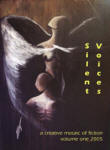
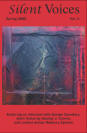
is evident in the subtle cover, one that contrasts the editor’s less
than subtle opening note. “Birth,” a multimedia-drawn sensual
silhouette of a woman, by Kevin Hayes, fits the editors’ red
background in size and in such a way that the viewer must come
closer, and so, enter the journal.
The issue bookends as follows: It
begins with Marie Lecrivain’s “The Word Thief,” an interesting take
on the idea of writing and ownership, followed by Stanley J.
Corwin’s enigmatic “The Perfessor” and ends with Paul Major’s
transformative Wolf novel excerpt followed by the George Saunder’s
interview (that can be found on the website:
www.exmachinapress.com), in which the author discusses his muses, the problem (for writers)
of being corralled into generalized categories or stamped with
labels, the relationship between teaching and writing, the idea of
having something to write about ... from experience rather than
academe or workshops, and ultimately, whether we will see more from
this writer. (We will.) The interview is thoughtful; Saunders
remains articulate and dynamic, yet, to end the journal with this
particular form does not leave the reader with the most moving exit,
if he has chosen to peruse from cover to cover. One of the “silent
voices” in a story would make for a stronger anchor or ethereal
sendoff.
The pieces that truly stand out, that kept this reader
actively interested in pushing forward, sometimes effortlessly and
not because this review was promised upon reading completion, are
Susan E. Briggs’ “Going Under” and Rebecca Epstein’s 2006 Silent Voices
Contest Winner “Where We Go,” and to a lesser extent though each has
beautiful moments, Emily Rapp’s “Francesca Woodman Prepares” and
Jessica Mehr’s “Astronomy, For the Lost.” The problem, if one may
call it that, shows in a stack: The four stories, interestingly all
written by women, appear almost consecutively in the thick of the
publication (editor T.S.D. Salvini’s exploration of a new
relationship in “Episodes” mixes in), when the editors could have
spread them out to connect and guide the whole issue. And on a
darker, quieter note, Briggs’ frozen landscape and struggling mother
would have made for a powerful final piece. The title “Going Under”
speaks to the end possibility, finishing the journal, life changing
form, alone we are again.
* * *
Writers are taught or encouraged not
to mistake the artist and her character. One of fiction’s roles
remains an allowance for, in Balaska’s interpretation of Joseph
Campbell (The Hero’s Journey) and Joseph M. Marshal III (The Lakota
Way), the “[eventual] gain [of] a kind of divine wisdom which leads
to spiritual progression” when we write about various hardships and
create characters that help guide us. From those characters, we
learn, and so, we discover ourselves. Therefore, fiction enables us
“[to] experience . . . our numerous struggles.”
Mehr, again, a woman
writer (this may be a disservice to her and in violation of
Saunder’s labeling as mentioned in his interview), creates a
narrative or philosophical treatise wherein the reader enters the
mind of the male protagonist, who waits to be removed from his
vehicle via rescue jaws after a severe wreck in a snowstorm, a blank
field. He rests, trapped with his thoughts as writers often are, and
sees his girlfriend Katie, a muse he has known for years but only
recently discovered in a romantic role, lying motionless in the
road. At this point, he may be relieved as “she is covered up to her
neck with a sheet to keep her from getting cold. No one stands
around her because she does not need their attention. She hasn’t a
single scratch on her but is perfect, white and pristine.” But we
know better, and in the moment both the character and the writer
make moves, plot decisions with larger implications.
Emily Rapp’s
“Francesca Woodman Prepares” offers third person insight into the
inner life of an artist consumed not only by her own work and the
play of light on objects, but by herself as its muse. The
character’s favorite photograph of herself shows “her face hidden,
her body dressed in an antique black dress unbuttoned to the waist.
Between her breasts is an imaginary wound that drips down her
stomach. ...” The story’s title indicates or hints where the plot
will end, and the narration successfully weaves backwards and
forwards in a manner that enhances the depth of the main character,
of charting her preparation.
In “Going Under,” Susan E. Briggs
illustrates a double tragedy on an icy lake, the stark picture of
winter, and the sudden mortality and power of a mother and a son’s
connection to each other and the landscape. Because of its dark
content, it shows partly reminiscent of a scene from one of the
shorts in Dekalog, a Polish collection of films by Krystof
Kieszlowski, but there is something distinctly northern American in
Briggs’ work — the names of the characters — the mother Bennie, her
husband Mal, a friend Jerry; the dialogue and the approaching
birthday party the day of the described event; and young Luke’s
boyhood, verging on adolescence, on the nearby lake and the Palamungut River. In the end, one might say that Mother knows her
son the best, and her sorrow and drive to be with him are
unquenchable.
And reading smoothly throughout, Rebecca Epstein’s
contest winner “Where We Go” has the descriptive yet still empty or
numb teenage youth-at-risk characters it evokes in an asylum . . .
perhaps calling one back to Ken Kesey’s Chief. The piece’s tone and
internalization connects to a later piece, Marika Lindholm’s “Winter
at Eldgarn,” the silent “interminable march of my physical prison,”
recalling, roughly, Dalton Trumbo’s hollow, unheard veteran.
However, Epstein’s work omits one-sided dialogue directed at the
protagonist and uses different targets in the second person,
sometimes addressing the reader —“You might pass her on the street...” sometimes relaying her storyteller’s and others’ positions as
nurses address her in the narration: “Pull down your pants they say
and they move in closer, and we back up into the corner, hiccupping
and shaking our head, No, no I won’t. We can give it to you in your
arm, they say..."— strangely and powerfully silent.
* * *
Finally,
the function of the website www.exmachinapress.com warrants
attention. Stepping out of the print form, the online resource
serves to: house samples of writing to an additional audience and
for potential submissions, stand as a resource to writers for
discussions on the creative process and, practically, on getting
published, offer an easy format for submitting to Silent Voices and
its contests, maintain a book and journals shop, feature its staff’s
work, and house links to other journals and sites, which have
featured members of the extended Silent Voices and Ex Machina Press
family.
Overall, Silent Voices successfully carries the silent room
of new fiction to the reader, as per its explicitly stated editor’s
mission, and, furthermore, a number of the stories resonate
internally—with a dark take on the psyche and the lonely, sometimes
quiet, often pained creative process of the writer. When I come
across the next issue as I expect to, for Balaskas and company mean
to continue with this project and continually improve their product,
I will pause and pick up a copy and follow the cohesive vision into
its maturity.
|